Services
Industries
Tools
Law Firm SEO in North Carolina That Brings Qualified Inquiries
Law firm SEO helps people find your practice when they search online for legal help. It connects your practice-area pages, local listings and useful information with people who may need your services. It should also help you see which searches lead to calls, consultations and signed matters.
Thirty calls sound good. Five signed matters tell you what the work is worth.
What Law Firm SEO Covers
Law firm SEO is the work that helps a law firm appear in relevant search results and gives potential clients a clear reason to get in touch. It covers your website, Google Business Profile, legal directory listings, useful content and the way you track new inquiries.
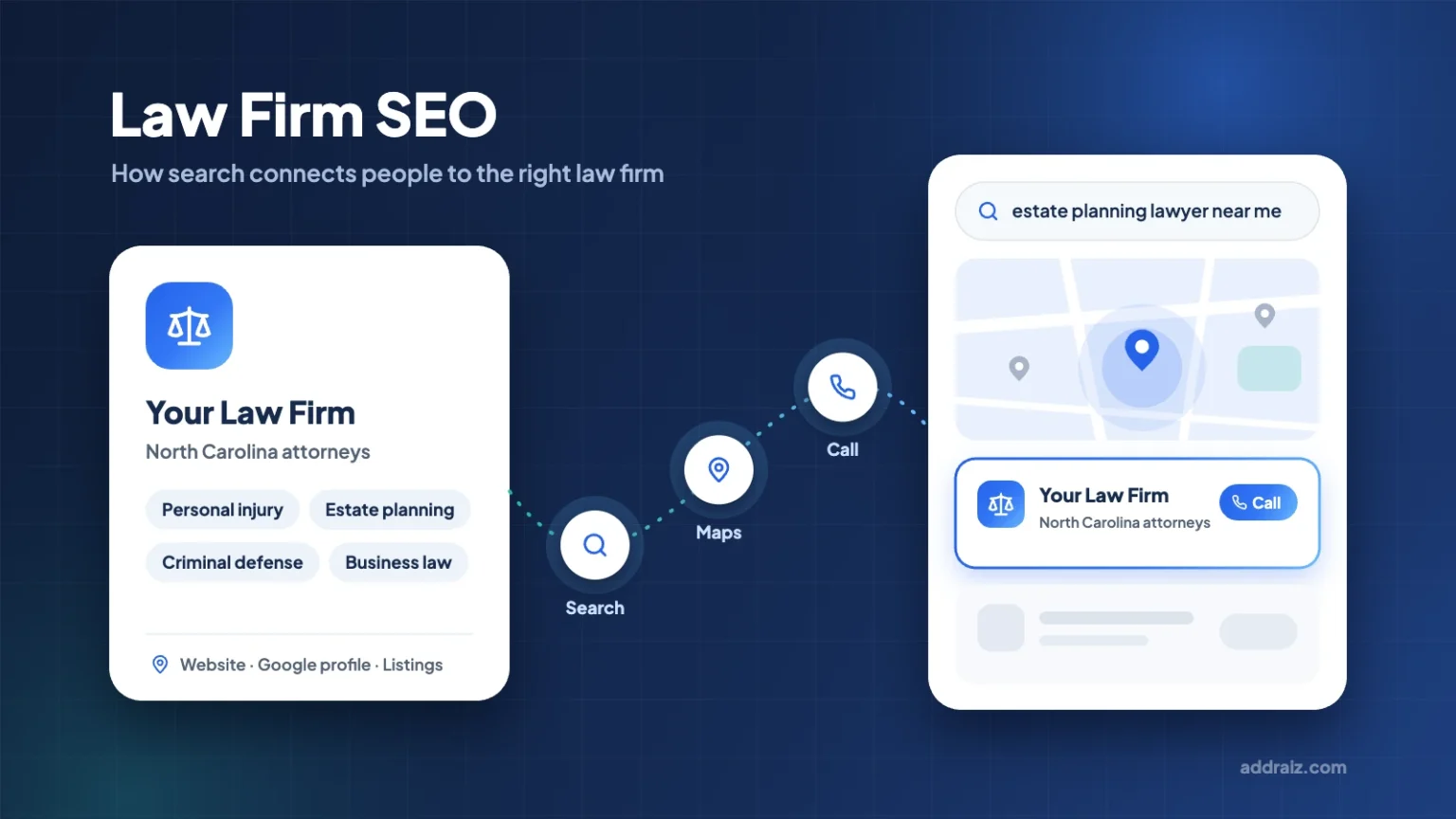
A person in Raleigh searching for an estate planning attorney might compare several firms before making a call. They may want to know which attorneys handle wills and trusts, where the office is, and what to bring to an initial meeting. A page that simply says your firm offers estate planning won’t answer much of that.
A good page gives that person enough information to decide if your firm is a good fit, and it makes the next step easy. The same applies to someone looking for a personal injury lawyer, criminal defense attorney or business law firm, although the questions and urgency will differ.
SEO won’t decide whether a person has a strong legal case. It helps the right person find your firm and understand what to do next.
Is Law Firm SEO a Good Fit for Your Practice?
SEO can work well when people search for the legal services you offer, your firm can serve those people, and you have time to handle new inquiries. It may be a lower priority if nearly all your work comes through a small group of professional referrals and you don’t plan to build direct demand.
Start with how your firm gets work today.
SEO may be a good fit if:
- People search Google for your practice area and location.
- You want another source of inquiries beyond referrals.
- Your firm has time to respond to calls and consultation requests.
- You can explain which matters fit your practice and which don’t.
- An attorney can review legal content before it goes live.
- You have a budget for work that may take time to build.
It may be better to work on something else first if:
- Your firm has no reliable way to answer new calls.
- You can’t take on more cases or consultations.
- Your website gives visitors little information about your services.
- Most new work comes from a small number of professional relationships.
- You need new matters right away and can’t wait for search visibility to grow.
- Your budget would have a greater effect on intake, website repairs or a paid search test.
Before you sign an agreement, know what work you’re buying, who controls your accounts and how the firm will track new inquiries.
If referrals already keep the firm busy, you may not need a broad SEO campaign. A focused plan for one practice area or location could make more sense. If you have room for new matters but rely on word of mouth, search may give potential clients another way to find you.
What Work Goes Into a Law Firm SEO Plan?
A law firm SEO plan covers the website work needed to explain your services, answer client questions and help search engines find the right pages. The scope depends on your practice areas, locations and the condition of your current site.
Practice-area pages
Each main service needs a page that explains what the firm handles, who it helps and how a potential client can get in touch.
A personal injury page needs different information from an estate planning page. Someone looking for help after a crash may want to know which types of accidents the firm handles and how to reach someone. Someone planning an estate may want to understand wills, trusts and powers of attorney.
A single page listing every service rarely gives either visitor enough detail. Separate pages also give your firm a clearer way to see which services attract inquiries.
Location pages
A location page needs useful information about the firm’s work in that area. Changing the city name in an otherwise identical page won’t give visitors much reason to read it.
If your office is in Raleigh and you serve clients in Cary, Durham and nearby communities, explain that clearly. Don’t present a service area as an office. Each page needs accurate information about where the firm works and how a person can contact it.
Local Search, Google Profiles and Legal Directories
Local SEO for lawyers helps a firm appear when someone searches for legal help in a particular town, city or service area. Your Google Business Profile is one part of that work, alongside your website and legal directory listings.
Google says local results are mainly based on relevance, distance and prominence. Your firm can keep its information accurate and make its services clear, but it can’t control how far a searcher is from the office. Read Google’s guidance on local ranking.
Can individual attorneys have their own Google Business Profile?
Yes, some individual attorneys can have their own profile. Google identifies lawyers as individual practitioners. An attorney may qualify if they work in a public-facing role, have their own customer base and can be contacted directly at the verified location during the stated hours.
Google also has rules for several practitioners working at one address. A firm may have a profile for the office, while eligible attorneys may have separate profiles. The profile name must follow Google’s practitioner guidelines. Creating extra profiles to cover different practice areas isn’t a workaround.
Before creating or changing attorney profiles, read Google’s guidelines for representing a business. Check the individual practitioner rules and make sure each profile meets the requirements.
Which legal directories should your firm check?
Legal directories give people another place to find attorney information. They can also provide citations and links that support a consistent online presence.
Check your firm’s information on:
- Avvo
- Justia
- FindLaw
- Super Lawyers
- The North Carolina State Bar
Keep attorney names, office details, phone numbers, practice areas and biographies current. Claim profiles where appropriate, correct old information and deal with duplicate listings when the directory allows it.
A directory listing doesn’t replace your firm’s website. Your site remains the main place where a potential client can learn about the services, read attorney biographies and contact the office.
Reviews and local information
Reviews can help someone decide whether to contact your firm. They must come from genuine clients and follow the rules that apply to your practice. Don’t offer rewards for positive reviews or pressure clients to share details about a legal matter.
Be careful with public replies. Even a short response can reveal information if it confirms that someone was a client or refers to a case.
How Practice Area and Search Urgency Change the Plan
The right SEO plan depends on how people search for your legal service and how quickly they need help. Someone looking for a criminal defense attorney may need to speak with a person right away. Someone planning an estate may compare several firms over days or weeks.
Urgent searches: personal injury and criminal defense
Urgent searches often come from people dealing with a stressful event. They may search on a phone, scan a few results and call a firm that looks suitable.
Make the next step clear. Put the phone number where visitors can find it. Explain the types of matters the firm handles and how quickly the office responds. Don’t bury contact details under a long introduction.
The intake process matters just as much. If calls go unanswered, the firm may lose the opportunity before anyone reviews the website content. Set a clear process for missed calls, after-hours messages and urgent inquiries. Staff need to know when to pass a call to an attorney.
Considered searches: estate planning and business law
People looking for estate planning or business law help may compare services, experience and costs before getting in touch. These searches often need more explanation.
An estate planning page might cover wills, trusts, powers of attorney and planning for changes in family or financial circumstances. A business law page might explain the firm’s work with contracts, company formation, transactions or ongoing counsel, depending on the services it provides.
Give visitors a clear way to arrange a consultation or send an inquiry. A useful checklist or guide can help them prepare before speaking with the firm.
| Search type | What the page should do | What follow-up looks like |
|---|---|---|
| Personal injury | Explain the cases handled and make calling easy | Prompt call response and clear intake steps |
| Criminal defense | Explain the types of charges or matters handled and provide a direct contact path | Route urgent calls to the right person |
| Estate planning | Explain the planning services and documents involved | Offer a consultation and a list of information to prepare |
| Business law | Explain the firm’s business services and the clients it serves | Provide a clear inquiry form and follow-up suited to the matter |
Match the page and the follow-up process to the searcher’s situation. A person facing an urgent legal problem needs a quick path to someone who can help. A person planning for the future needs enough information to compare firms and prepare for a consultation.
How Much Does Law Firm SEO Cost in North Carolina?
The cost of law firm SEO depends on the number of practice areas, locations, website problems and content needs. A solo firm with one office and a focused service may need less work than a multi-office firm competing across several demanding practice areas.
A good proposal explains the work before it names a monthly fee. Look for a clear list of pages, content, website fixes, reporting and the people responsible for each task.
Don’t treat competitor prices as a reliable market average. The practice area, agency scope, location and condition of the website all affect a quote.
See our local SEO services in North Carolina for the published package details.
That price is for Addraiz’s Local SEO service, not a separate law-firm package. Your firm’s scope may change based on its website, practice areas, locations and content needs. Any extra work needs to be clear before it begins.
When comparing proposals, look beyond the monthly fee. Check the number of pages included, the amount of content, who reviews it, how local listings are handled and what happens if you end the agreement. A lower fee may cover very little work. A higher fee may include tasks your firm doesn’t need.
How Long Does SEO Take to Bring in Signed Matters?
SEO takes time because search engines need to find and assess changes, and people need time to discover the firm and decide whether to contact it. Some website fixes can happen quickly, but steady inquiries from organic search usually take longer.
The starting point matters. A website with clear service pages and accurate local information needs a different plan from a new site with little content and few local listings.
A sensible plan sets early tasks and review points without promising a date for rankings or signed cases. In the first months, you may see pages indexed, better visibility for some searches or more activity on the Google Business Profile. Those are signs of progress, not proof that the work is producing profitable matters.
A new firm also needs a way to bring in work while SEO develops. Paid search, referral relationships and existing professional networks may help fill that gap. The right mix depends on the firm’s budget, case value and ability to respond.
SEO, Google Ads and Local Services Ads Compared
SEO is one way to reach people searching for legal help. Google Ads and Local Services Ads offer other routes, but each works differently and needs its own budget and follow-up process.
| Channel | How it works | Best use | Main limit |
|---|---|---|---|
| Organic SEO | Your website and local presence appear in unpaid search results | Building visibility for relevant searches over time | Takes time and ongoing work |
| Google Search Ads | Paid ads appear for selected searches | Testing demand or reaching people sooner | You pay for clicks and need to manage spend |
| Google Local Services Ads | Eligible firms can appear in a dedicated local ad placement and receive calls or messages | Reaching people searching for legal services in eligible categories and locations | Eligibility, screening, budget and lead handling all matter |
| Referrals | Other professionals or past clients refer people to the firm | Practices built around trusted relationships | Volume may depend on a small number of referral sources |
| Legal directories | People find attorney profiles on sites such as Avvo and Justia | Supporting discovery and checking attorney details | A profile doesn’t replace your firm’s website |
What are Google Local Services Ads for lawyers?
Google lists lawyer categories for Local Services Ads, including personal injury, criminal, estate, family, bankruptcy and business law. Eligible providers go through Google’s screening and verification steps, which can vary by category and location. Check Google’s getting started guide for Local Services Ads to see whether a specific firm can participate.
Local Services Ads can generate calls and messages, and firms can manage leads through their account. Your team still has to respond promptly and decide whether each inquiry fits the practice. A screened or verified badge isn’t a guarantee of legal skill or a case outcome.
Should your firm use SEO and paid ads together?
They can work together when each has a clear job. Paid search may help test demand or bring in inquiries while organic visibility develops. SEO can build pages and local information that continue to attract relevant searches over time.
Don’t split a small budget across every channel without a plan. Start with the channel that fits the firm’s immediate need, then review the quality and cost of the inquiries it brings in.
How to Choose an Agency and Keep Control of Your Accounts
A good agency explains the work in plain language, shows what it will change and gives your firm access to the accounts used to measure performance. You shouldn’t have to rely on a monthly PDF to know what’s happening.
Before signing, check these points:
- ScopeDoes the proposal name the pages, profiles, content and website work included?
- Practice-area knowledgeCan the agency explain how it will handle different legal services without pretending to give legal advice?
- Content reviewIs there a clear step for attorney review before legal content goes live?
- ReportingWill you see calls, forms and consultation activity as well as rankings and traffic?
- AccessWill the firm keep administrator access to its website, Google Business Profile, Search Console, Analytics and ad accounts?
- LinksCan the agency explain where links come from and why those sites are relevant?
- ContractAre the fee, deliverables, term, cancellation process and extra charges written down?
- ClaimsDoes the agency avoid promises of number-one rankings, guaranteed leads or guaranteed AI recommendations?
Keep ownership of your accounts
Your law firm should own the accounts that hold its business information and performance history. An agency can receive the access it needs to do the work, but the firm’s owner or an authorized staff member keeps control.
| Asset | Who owns it | What to confirm |
|---|---|---|
| Domain name | The law firm | The firm controls the registrar login and renewal |
| Website and hosting | The law firm | Admin access, backups and transfer details are available |
| Google Business Profile | The law firm | A firm representative is an owner; the agency has manager access if needed |
| Search Console | The law firm | The firm has full access and can add or remove users |
| Analytics | The law firm | The firm can view the data and manage permissions |
| Google Ads and Local Services Ads | The law firm | Billing and account access stay under firm control |
| Content and images | Set out in the contract | The agreement states what the firm can keep and reuse after the work ends |
Don’t let an agency create these accounts under an employee’s personal email or keep the only administrator login. If the relationship ends, you shouldn’t have to rebuild your website or start tracking from zero.
Browse our SEO case studies to see the type of reporting and outcomes Addraiz publishes. These examples aren’t law-firm case studies, and they aren’t a promise of legal-industry results.
Your First 90 Days
The first 90 days establish the firm’s starting point, fix important problems and improve the pages that support its main services. The order may change if the website has serious technical issues or the firm has urgent intake problems.
Review the website, Google Business Profile, directory listings, analytics and current inquiries. Confirm account access, correct contact details and plan priority fixes and practice-area pages.
What you’ll haveBaseline report, access check, priority list and page plan
Improve the main practice-area pages, fix website problems, add useful content and review local information and attorney profiles.
What you’ll haveUpdated core pages, supporting content and corrected business details
Review directory listings, local mentions, review response process, search visibility, calls and forms. Check inquiry quality and agree on next-quarter priorities.
What you’ll haveProgress report and a clear plan for the next quarter
Your firm has a part to play during this period. Provide accurate service information, confirm which locations the firm serves, give the agency access to the right accounts and assign an attorney to review legal content.
The attorney doesn’t need to write every page. The agency can prepare the content, but someone at the firm has to check the details and approve publication. Delayed approvals or missing information can slow the work.
How to Track Calls, Consultations and Signed Matters
A useful SEO report shows whether the work is reaching the right people and whether those people become potential clients. Website traffic and rankings help explain visibility, but they don’t tell you how many suitable matters the firm signed.
Set up tracking before major changes begin. Record form submissions and phone calls, and make sure the intake team notes where each inquiry came from. If someone calls after finding the firm on Google, keep that source in the firm’s records.
For example, say your firm gets 30 calls from Google in one month. Thirty calls may sound like a good result, but you still need to know how many callers had matters the firm handles, how many booked consultations and how many signed engagement agreements.
The intake team can help sort those calls into useful groups. Maybe 18 fit the firm’s practice areas, 12 booked consultations and 5 signed. That tells you far more than the call total alone. It also gives the firm a starting point for reviewing missed calls, follow-up and the quality of the pages bringing people in.
| Measure | What it tells you | What to review |
|---|---|---|
| Search impressions | How often pages appear in search results | Which practice areas and locations are gaining visibility |
| Search clicks | How many people visit from unpaid search | Whether the page title and result attract the right visitors |
| Google Business Profile actions | Calls, website visits and other profile activity | Whether local searchers take the next step |
| Phone calls | How many people contact the firm by phone | Call quality, missed calls and suitable matters |
| Form inquiries | How many people submit a website form | Whether forms are complete and relevant |
| Consultations booked | How many inquiries become scheduled conversations | Which channels bring people ready to speak |
| Signed matters | How many consultations become clients | Whether the marketing produces business value |
| Cost per signed matter | Marketing cost divided by signed matters | Whether the spend makes sense for the practice area |
Keep a record of unsuitable inquiries too. A page may attract many calls but still bring people with matters the firm doesn’t handle. That points to a targeting problem, even if traffic is rising.
Review the numbers with the people who handle intake. They can explain why some inquiries were useful and others weren’t. Each monthly meeting should end with a decision: keep the current plan, improve a page, change the target service or fix a problem in the response process.
Google’s AI search features don’t remove the need to measure results. Google says the same core search practices apply to AI Overviews and AI Mode, but appearance isn’t guaranteed. Search Console includes AI feature traffic within overall Web performance data. Read Google’s guidance on AI features and websites.
Attorney Review Checklist
Every legal page needs a named attorney or qualified reviewer to check the facts before publication. A writer or SEO agency can organize the page, improve its wording and make it easier to find, but the firm remains responsible for its legal communications.
Use this checklist before a new page or article goes live:
- The page describes services the firm actually provides.
- The named attorney is licensed and listed accurately.
- The biography, education, admissions and experience details are current.
- Any claim about results has supporting facts and the right context.
- The page doesn’t promise a result or suggest that every case will have the same outcome.
- Comparisons with other lawyers or firms can be supported.
- Testimonials and reviews are genuine and handled in line with applicable rules.
- The page doesn’t reveal confidential client or case information.
- The firm’s name and office address appear where required.
- A qualified attorney has approved the final copy.
Attorney bios and “reviewed by” lines
An attorney biography tells visitors who the lawyer is, what work they handle, where they’re licensed and what experience relates to the page. Avoid vague claims such as “leading lawyer” unless the firm can support the wording and the statement fits the rules.
A “Reviewed by” line shows that an attorney checked a legal article. Include the attorney’s full name, role and relevant credentials, and make sure the review happened. Don’t add a reviewer’s name as decoration or suggest that an attorney approved content they haven’t read.
North Carolina Rule 7.1 says lawyer communications must not be false or misleading, including claims that create unjustified expectations about results. Rule 7.2 also covers lawyer advertising. Review the current North Carolina State Bar Rule 7.1 and Rule 7.2 with the firm’s ethics counsel when needed.
How Addraiz Helps Law Firms
Addraiz provides Local SEO services that help businesses appear in Google Search and Maps. For a law firm, that work can include local keyword research, Google Business Profile optimization, local on-page SEO, technical SEO, citations and listings, local link building, and reputation and review management.
We can review the firm’s current search presence, check its business information and plan improvements around the practice areas and locations it serves. Our work also includes SEO and GEO planning, content improvements and AI visibility monitoring across supported platforms. Tracking setup is included where account access allows.
The firm supplies accurate service details, attorney information and legal approval. We handle the agreed search work and report on progress. We don’t promise rankings, signed matters or placement in AI answers.
To talk through your firm’s search presence, contact us.
Frequently Asked Questions
What does my firm need to provide before SEO starts?
You’ll need to provide accurate practice-area details, attorney biographies, office and service-area information, access to your website and Google accounts, and a person who can review legal content. Intake records also help establish which inquiries fit the firm.
Can a North Carolina law firm appear in Google AI Overviews?
A law firm’s pages may appear in AI Overviews if Google selects them for a response, but no agency can promise that placement. Clear service information, useful content and sound technical SEO give search engines pages they can understand and assess.
How should a solo attorney choose the first practice area to target?
Start with the service the firm wants more of, has capacity to handle and can describe clearly. Review the searches people use, the firm’s current pages and its ability to respond to inquiries. Build a focused page before spreading the budget across every service.
 Get started
Get a Clear View of Your Firm’s Search Visibility
Your firm should know which searches bring the right people, what the website needs and how new inquiries are handled. Addraiz can review your current search presence and outline practical next steps.
No agency can promise rankings or signed cases. A clear plan gives your firm a better way to judge the work, the cost and the results.